



A background music system needs three things working together: a licence that actually covers commercial use, hardware that keeps playing reliably through a full trading day, and a way to control what’s on and when. Skip any one of the three and the whole thing falls apart. You end up unlicensed, or stuck with a consumer speaker that can’t handle eight hours of continuous play, or unable to change the playlist without someone driving out to the store.
Whether you’re running a single shop, a restaurant, or a multi-site franchise across South Africa, here’s what actually matters before you commit to a commercial background music system.
Key Takeaways
- A business background music system needs three parts: commercial licensing, dedicated hardware, and playlist control.
- Major Label music means SAMRO/SAMPRA licence fees in South Africa – DMX doesn’t cover these on a client’s behalf.
- Rights-included/royalty-free catalogues (DMX’s runs to 4,000+ tracks) skip those particular licence fees.
- Multi-location businesses need a centrally managed platform, not separate playlists per site.
- DMX’s Harmony Music lets businesses self-manage their sound through Mixes, Stations, or Programs.
What Counts as a Background Music “System” for a Business?
It’s tempting to treat background music as just “hit play on a playlist.” But a personal streaming account and a commercial background music system are two different things – and the gap between them only becomes obvious the day someone asks for your licence.
Well-run in-store music systems for a business cover four things:
- Commercial licensing – the legal right to play music in a place of business, not a home listening licence
- Dedicated hardware – a media player and speaker setup built to run all day, not a phone plugged into a speaker
- Scheduling and control – setting what plays and when, without needing someone on-site to change it manually
- Consistency across locations – keeping every site sounding like the same brand, once you’re beyond one location
A restaurant background music system and background music for retail stores need the same four building blocks. What changes is the mood, the tempo, and how closely the playlist has to track service pace or shopping flow.
Licensing – Commercial vs Royalty-Free/Rights-Included Music
This is where most businesses trip up – mainly because it’s invisible until it isn’t.

Major Label (Commercial) Music means tracks by signed artists on record labels. Play this in a South African business and you need licence fees to SAMRO and SAMPRA. There’s a real case for going this route: you get original recordings from decades-old classics through to whatever’s on the charts right now. One thing worth knowing upfront, though – DMX doesn’t cover SAMRO or SAMPRA fees on a client’s behalf. Those get billed separately, straight from the licensing bodies.
Royalty-Free (Rights-Included) Music is what a lot of South African businesses choose instead. DMX’s own rights-included catalogue holds thousands of professionally produced tracks across dozens of styles, with no SAMRO or SAMPRA fees attached. It draws on independent, unsigned, and emerging artists from around the world – so the production quality stays high, but the cost and admin drop away.
Neither option wins outright. A fine-dining restaurant chasing a recognisable, classic soundtrack might lean commercial. A retail chain running the same playlist across a dozen branches might prefer the simplicity of rights-included music instead. It comes down to budget, brand, and how much licensing admin you’re willing to take on.
Major Label vs Royalty-Free Music
| Major Label (Commercial) Music | Royalty-Free (Rights-Included) Music | |
|---|---|---|
| Licensing | Requires SAMRO/SAMPRA fees (SA) | No SAMRO licence fees on this catalogue |
| Artist type | Signed, globally recognised artists | Independent, unsigned, emerging artists |
| Best for | Brands wanting recognisable original tracks | Brands wanting cost-effective, hassle-free audio |
| Catalogue size (DMX) | Full commercial catalogue | 4,000+ exclusive curated tracks |
Hardware & Setup – Media Player, Speakers, Multi-Location Control
Licensing sorted, the next question is simpler: what actually plays the music, and who manages it day to day.
A commercial background music system runs off a dedicated media player wired to your speakers – not a phone or a laptop plugged in and hoped for the best. That matters for one reason: reliability. A system built for business use keeps running through the full trading day, every day, without the dropouts or manual restarts you’d get from a consumer device.
What this looks like in practice depends on how big the business is:
Single-Location Retail Store

A single store just needs something simple to set up, with no ongoing technical management. Cloud-based platforms like the Harmony platform let a store manager build a playlist from hundreds of micro-genres, adjust it by mood or tempo, and manage all of it from a mobile device – no on-site IT person required. For retail background music, that level of self-service control is usually all you need.
Multi-Location Franchise or Restaurant Group

Things get more complex once a brand needs the same sound – or a controlled variation of it – playing across multiple sites at once. Centrally managed platforms solve that by letting one person schedule and update music for every location from a single dashboard, instead of leaving each site to run its own playlist. Franchise groups and hospitality brands feel this most: they want every location to sound like the same brand, whether that’s restaurant background music tuned to the pace of service or a retail soundtrack that stays consistent nationwide.
Single-Location vs Multi-Location Setup
| Single-Location Setup | Multi-Location Setup | |
|---|---|---|
| Control | Store-level playlist management | Centrally managed across all sites |
| Best for | Independent retail stores, single restaurants | Franchises, restaurant groups, hospitality chains |
| Platform | Harmony Music (self-managed) | Harmony Music (centrally managed, mobile-friendly) |
How Much Self-Control Do You Want Over Your Playlist?
Ask yourself this before signing with any provider – it shapes your day-to-day experience far more than the hardware ever will.
Some background music systems are closed, top-down services: you pick from a handful of pre-built stations, and that’s it. Others give the business real control over its own sound – choosing genres and styles, fine-tuning by tempo and mood, blending in self-recorded ads between tracks, adjusting playlists for the season, the time of day, or an in-store campaign.
Harmony Music, DMX’s platform, is built around the second model. There are three ways to build a soundtrack, depending on how much direction you’ve already got in mind:
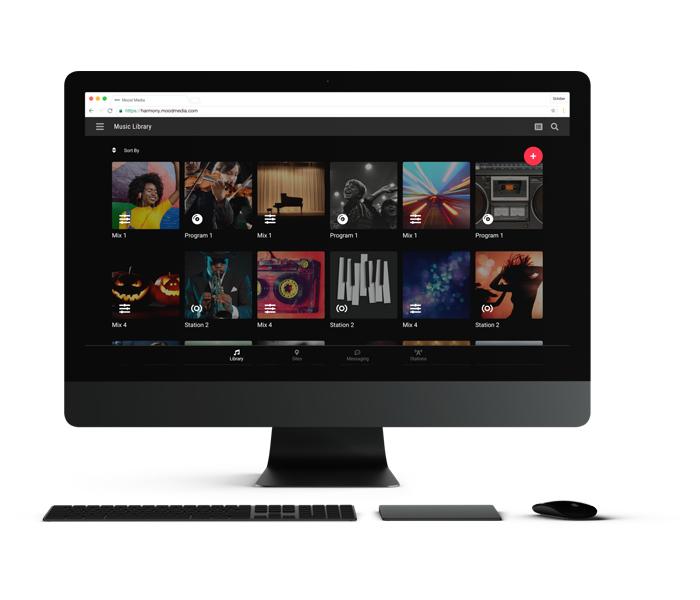
- Mixes – build a soundtrack from hundreds of micro-genres, fine-tuned by tempo and mood
- Stations – search for “seed” tracks, artists, or albums with a similar sound, and let the system’s music design technology build a matching soundtrack
- Programs – choose from 150+ professionally designed, regularly refreshed playlists and simply press play
There’s also in-music messaging, which lets a business blend its own recorded ads, promotions, or announcements straight into the playlist – creating something close to a branded, radio-like channel that can nudge decisions right at the point of purchase. Want something fully bespoke? A dedicated music designer can build and regularly refresh a soundtrack unique to the brand.
How much control you actually want is your call. But it’s a lot easier to pick a system with that flexibility built in from day one than to switch providers later because the one you’re on can’t grow with your brand.