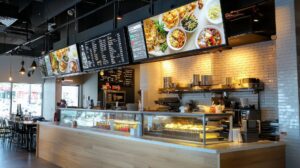


Restaurants, cafes and quick service restaurants (QSR) don’t all use digital signage the same way – and that’s exactly where most buying decisions go wrong. A full-service restaurant needs something very different from a coffee shop, and a QSR with a drive-thru has requirements neither of the other two do. This guide breaks down digital signage boards by venue type, so you can see which solution actually fits how your business operates before you invest in screens, content or a supplier.
Which Solution Fits Your Business?
- Full-service restaurant → Promotional and ambience screens, front-of-house menu displays
- Cafe or coffee shop → Compact digital menu boards, daily specials and upsell screens
- QSR or drive-thru → High-visibility digital menu boards, indoor promo screens and weatherproof outdoor drive-thru displays
If you already know your venue type, jump to the relevant section below. If not, read through all three – many multi-format venues (think bakery-cafes or QSR chains with dine-in seating) need a combination.
Digital Signage for Full-Service Restaurants
In a full-service restaurant, digital signage isn’t primarily about the menu – table service already handles that job. Instead, screens are used to shape the dining environment and support the front-of-house experience: welcome screens at the host stand, promotional content for specials, events or seasonal offerings, and ambience-driven visuals that reinforce the restaurant’s brand and atmosphere.
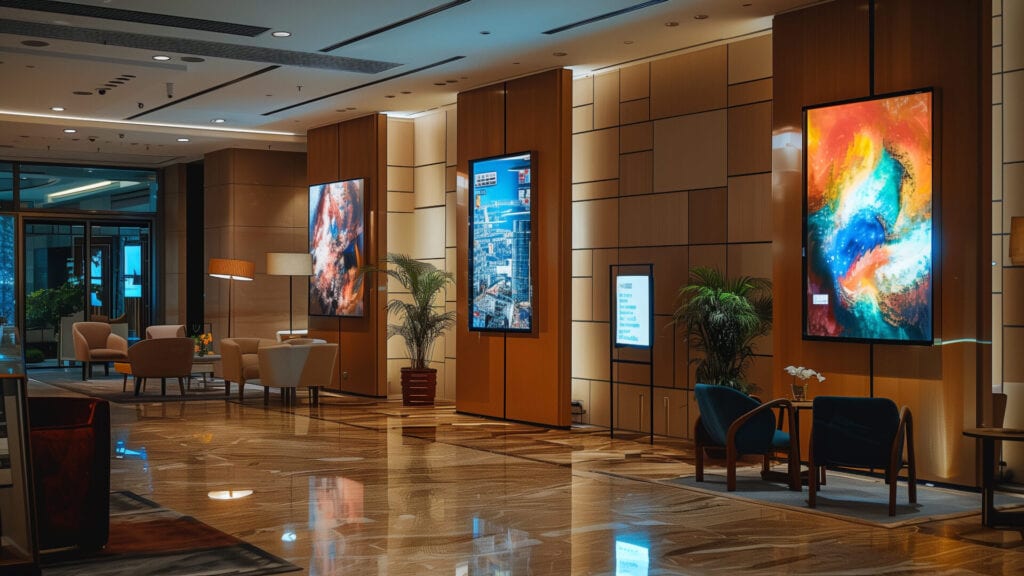
Because these screens are viewed at close range in a seated, relaxed environment, content pacing matters more than raw visibility from a distance. Restaurants also tend to update content less frequently than QSRs – seasonal menus, evening specials, or wine and cocktail promotions – so a content management system that lets on-site staff make quick changes without waiting on a design agency is a practical requirement, not a nice-to-have.
Digital Signage for Cafes and Coffee Shops
Cafes operate on tighter counter space and faster customer decision-making than full-service restaurants. Digital signage here typically takes the form of compact digital menu boards positioned above or behind the counter, showing core menu items, daily specials and limited-time offers that can be swapped in minutes rather than requiring new printed boards.
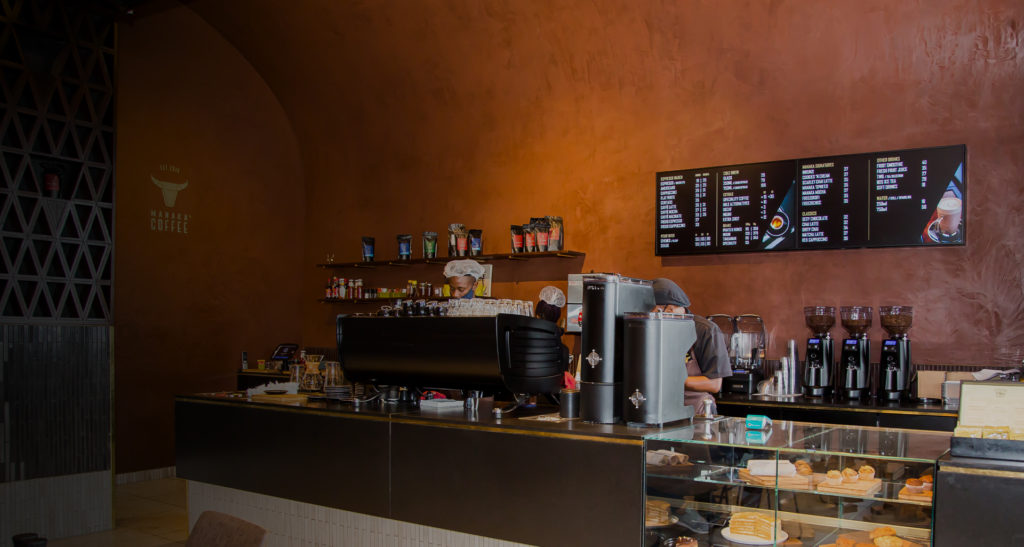
This is also where upselling has the most visible impact – a well-placed screen promoting a pastry-and-coffee combo or a seasonal drink can influence a purchase decision in the few seconds a customer has at the till. Because cafes often run on smaller teams without dedicated marketing staff, ease of self-managing content is a key consideration when comparing digital signage for cafes.
Digital Signage for Quick Service Restaurants (QSR) and Drive-Thru
QSR environments have the most demanding signage requirements of the three, because they combine high customer throughput, multiple viewing zones and – in many cases – outdoor exposure. A typical QSR setup needs to account for:
- Indoor digital menu boards at the front counter, built for legibility and quick scanning under queue pressure
- Secondary promotional screens for combo deals, loyalty offers or new product launches, separate from the core menu
- Drive-thru displays that are weatherproof, viewable in direct sunlight, and able to sync pricing and availability with the indoor menu boards in real time

Quick service restaurant digital signage also has to hold up to longer operating hours and higher device counts across multiple locations, which makes centralised, cloud-based content management essential – a franchise group running ten stores can’t afford to update ten menu boards individually every time a price changes.
Choosing a Reliable Digital Signage Supplier
Not every digital signage supplier is set up to service the hospitality sector well. When comparing digital signage suppliers for a restaurant, cafe or QSR rollout, look beyond the screen itself and consider:
- Track record with hospitality clients – has the supplier delivered signage for restaurants, cafes or QSR chains before, or only retail and corporate environments?
- Content management flexibility – can your own team update menus and promotions, or are you locked into paying the supplier for every change?
- Hardware suited to the environment – commercial-grade displays built for extended daily runtime, not consumer TVs, plus outdoor-rated hardware where a drive-thru is involved
- Multi-site support – the ability to manage content across several branches from one dashboard, critical for franchise and multi-location operators
- Ongoing support – installation is only the start; ask how updates, troubleshooting and hardware issues are handled after go-live
DMX Africa has supplied digital signage to hospitality and retail brands across South Africa since 1996, with content managed through the cloud-based Harmony platform – giving restaurant, cafe and QSR operators direct control over their own menu and promotional content rather than depending on a third party for every update.
What to Look for in a Restaurant Digital Signage Solution
Whatever type of venue you’re running, a genuinely fit-for-purpose restaurant digital signage solution should give you:
| Requirement | Why it matters |
|---|---|
| Commercial-grade displays | Built for all-day, every-day operation – unlike consumer TVs, which aren’t designed for continuous commercial use |
| Self-managed content | Update prices, specials and promotions in-house, without waiting on external design or IT support |
| Menu board layout templates | Legible, well-structured boards that speed up ordering rather than slowing it down |
| Multi-location syncing | The multi-display solution provides the flexibility to display unique menu content on each screen while enabling full-screen synchronization for promotional campaigns. |
| Outdoor/drive-thru capability | Weatherproof, sunlight-readable displays where drive-thru or outdoor viewing is part of the format |
| A media player behind every screen | Every display needs a media player driving its content – this is what turns a screen into a signage system rather than just a monitor |
Comparing Digital Signage Needs by Venue Type
| Venue Type | Primary Use | Update Frequency | Key Requirement |
|---|---|---|---|
| Full-Service Restaurant | Ambience, promotions, front-of-house screens | Low to moderate | Brand-aligned visual content, easy seasonal updates |
| Cafe / Coffee Shop | Digital menu boards, upsell promotions | Moderate to high | Compact format, fast self-managed changes |
| QSR / Drive-Thru | Menu boards, promo screens, outdoor drive-thru displays | High | Multi-site sync, outdoor-rated hardware, high visibility |
Choosing the Right Fit for Your Venue
Whether you’re running a full-service restaurant refreshing its evening specials, a cafe that needs faster counter-side upselling, or a QSR chain juggling indoor menu boards and a drive-thru, the right digital signage setup comes down to matching the hardware and content management to how your venue actually operates.
DMX Africa works with restaurants, cafes and QSR operators across South Africa to build signage solutions around the way each venue runs – from DMX digital menu boards for counter and drive-thru use, to broader screen solutions for restaurants and bars and quick service restaurants. Get in touch for a tailored recommendation for your venue.