Home » CASE STUDIES & ARTICLES » What Is a Video Wall? Types, Sizes & How Digital Wall Displays Work
What Is a Video Wall? Types, Sizes & How Digital Wall Displays Work
A video wall is a large-format digital display made up of multiple screens or LED panels tiled together so they work as one seamless image. Businesses use it for advertising, branding and customer-facing information – turning a wall, storefront or reception area into a moment people actually notice. In South Africa, DMX Africa designs and installs DMX video wall solutions for retail, hospitality, corporate and restaurant environments, all managed through the Harmony content management platform.
Key Takeaways
- A video wall combines multiple LED or LCD screens into one large, seamless display.
- LED panels suit large-format and outdoor use. LCD panels suit close-up indoor viewing.
- Video walls can be wall-mounted or freestanding, in almost any size or shape.
- A content management platform like Harmony handles the content, so updates happen in real time across one location or many.
- In South Africa, video walls show up across retail, hospitality, corporate and restaurant spaces.
How Does a Video Wall Work?
A video wall works by mounting multiple display panels – LED or LCD – edge to edge, so they operate as one large canvas instead of several separate screens. A media player connected to the panels, combined with content management software, treats the whole configuration as a single display. That’s what lets a video wall show one large graphic, or split into multiple content zones, depending on what a business needs to say.
DMX video walls are managed through the Harmony content management platform, DMX’s own software layer. It lets businesses change what’s showing – from a single screen to an entire multi-location network – without needing on-site technical support for every update.
Types of Video Wall Displays
LED Video Walls
LED video walls use individual light-emitting diode panels. They’re bright, they hold up well at typical viewing distances, and they’re built for large-format installations. Because LED panels can come in weatherproof, IP-rated housings, they’re also the go-to choice for outdoor video walls – retail storefronts exposed to direct sunlight, for instance.
LCD Video Walls
LCD video walls use liquid-crystal display panels, which give sharper detail up close. They tend to work better indoors, where customers view the screen from just a metre or two away – reception areas, retail counters, restaurant entrances.
For a closer look at the underlying screen technology, see DMX’s commercial-grade LED and LCD screens.
Wall-Mounted vs Freestanding Displays
Most video walls are wall-mounted – fixed permanently to a wall in a lobby, retail space or restaurant interior. Freestanding setups exist too, for when a business needs the display positioned away from a wall – an open-plan retail floor, say – while still functioning as a permanent fixture.
What Is a Video Wall Used For? (Industries & Use Cases)
DMX designs video wall solutions around what each industry actually needs:
Retail
Video walls turn flagship storefronts and in-store displays into brand moments that actually stop foot traffic – window displays that catch the eye from the pavement, in-store screens promoting new arrivals and seasonal campaigns. See how this plays out on DMX’s retail video wall solutions page.
Corporate
In corporate environments, video walls handle internal messaging – training and support videos, HR and IT announcements, branding in reception and lobby areas. This overlaps closely with DMX’s workplace digital signage offering.
Hospitality
In hotels, lodges and other hospitality spaces, video walls deliver high-impact visuals for branding, promoting accommodation specials, or spotlighting local attractions. Explore DMX’s hospitality digital displays for more.
Restaurants & Bars
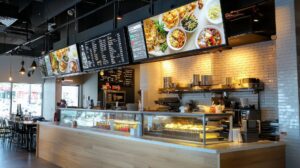
Restaurants use video walls and digital menu boards – managed through Harmony – to highlight daily specials, with pricing and offerings updated in real time. See DMX’s restaurant and bar digital displays for the full picture.
Video Wall vs Digital Signage vs Digital Menu Boards – What’s the Difference?
All three sit under DMX’s digital signage solutions, but each does a different job:
| Solution | Best For | Typical Use Case |
|---|---|---|
| Video Wall | Large-format branding and high-impact visuals | Flagship stores, lobbies, corporate branding |
| Digital Signage Display | Sales promotions, product education and interactive displays | Retail promotions, in-store customer messaging |
| Digital Shelf Display | Small-format, close-range in-store screens | Shelf-edge promotions, product information at the point of purchase |
| Digital Menu Board | Real-time menu and pricing updates | Restaurants, bars, quick service restaurants |
For more on the other formats, see digital menu boards and digital shelf displays.
How Much Does a Video Wall Cost in South Africa?
Video wall pricing comes down to a few variables: screen size, panel technology (LED vs LCD), whether it’s going indoors or outdoors, and the content management setup you need. Every installation is different, so DMX builds each quote around your specific space and budget rather than working off a fixed price list. Ready to get pricing for your space? Request a video wall quote.
Glossary
| Term | Definition |
|---|---|
| LED pitch | The distance between individual LEDs on a panel – the key factor in how sharp the image looks close up. |
| Bezel | The frame around a display panel. Video walls use narrow or seamless bezels so the panels read as one continuous image, not several screens stuck together. |
| Content management platform | Software (Harmony, in DMX’s case) used to schedule, update and manage what’s showing across one screen or many. |
| Media player | The device connected to a display that plays and outputs the content. |
| Commercial display | A screen built for continuous, always-on business use – not a consumer TV pulled from someone’s lounge. |
Frequently Asked Questions
What size video wall do I need?
That depends on your space, your viewing distance, and what you’re using it for. DMX designs custom configurations – from a single screen to a large multi-screen setup – based on your specific location.
What’s the difference between indoor and outdoor video walls?
Outdoor video walls need weatherproof, IP-rated panels that can handle sun, rain and dust. Indoor video walls skip that rating and focus on sharper close-up detail instead.
How long does video wall installation take?
It varies with the size and configuration of your video wall. You’ll get a clear timeline as part of your free consultation and quote.
Is a video wall the same as a TV wall?
Not quite. A “TV wall” is usually a group of separate televisions mounted together, each running its own content. A true video wall uses purpose-built panels and content management software, so the whole setup works as one seamless display.
Can a video wall show live or real-time content?
Yes. Managed through a platform like Harmony, a video wall can display live or regularly updated content – promotions, announcements, menu items – across one location or several.
Get a Video Wall Solution Built for Your Business
DMX Africa designs, installs and supports custom video wall solutions for retail, hospitality, corporate and restaurant businesses across South Africa, all managed through the Harmony content management platform. Explore DMX video wall solutions to get started.
BLOG POSTS